
Introduction
Every successful startup begins with a problem that needs to be solved. For Zomato, one of India’s most popular food-tech brands, the journey started with a simple but powerful insight: people waste time searching for restaurant menus. What began as a small side project grew into a platform used by millions. This startup journey shows how innovation, timing and steady scaling can turn an idea into an industry leader.
This blog breaks down Zomato’s journey step by step, covering the early years, key pivots, business model, growth strategies and important lessons for new entrepreneurs.
How the Idea Started
In 2008, Deepinder Goyal and Pankaj Chaddah were working at Bain & Company. Every day, colleagues would ask for menu cards from different restaurants before ordering lunch. Menu cards were often missing, outdated or hard to find.
Deepinder noticed this daily struggle and understood the root problem: there was no single place to view menus from multiple restaurants. He created a simple website where he uploaded scanned menus from nearby restaurants. The site was named FoodieBay, and it instantly became popular in their office.
The idea was simple and useful. That was the beginning of Zomato.
From FoodieBay to Zomato
As more people discovered the site, traffic grew fast. By late 2008, FoodieBay started listing hundreds of restaurants in Delhi NCR. Users liked the convenience, and the founders realized they could scale this beyond their workplace.
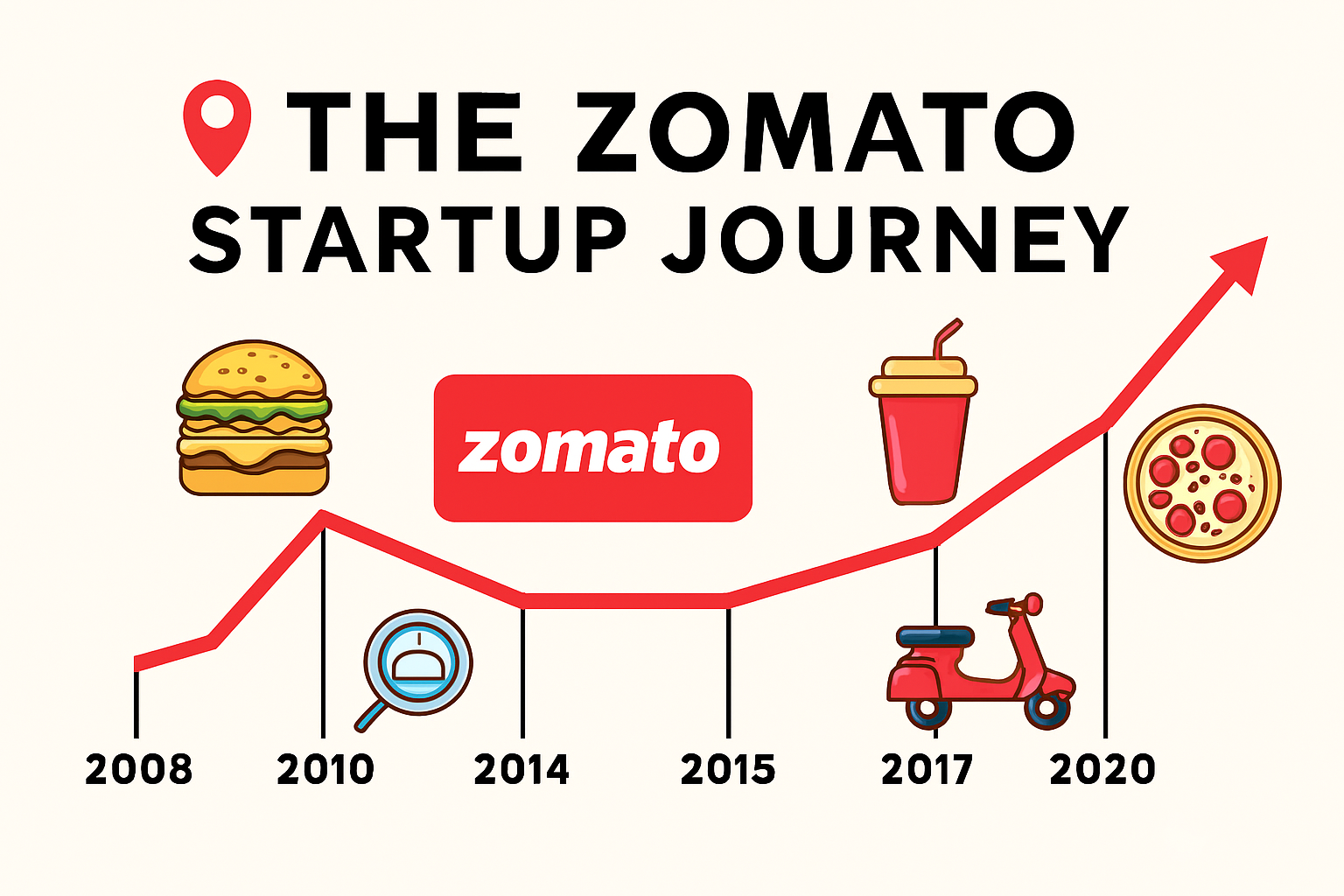
In 2010, FoodieBay rebranded as Zomato.
There were two reasons:
- They wanted a name suitable for global expansion.
- “FoodieBay” sounded too similar to eBay.
The new name was shorter, catchy, and easier to build as a brand.
Early Growth and Expansion
Once the platform gained traction in Delhi, the founders expanded to other metro cities. Between 2010 and 2012, Zomato launched in:
- Mumbai
- Bengaluru
- Chennai
- Pune
- Hyderabad
- Ahmedabad
The model worked everywhere because the problem was universal: people wanted reliable menus, ratings and restaurant details online.
Zomato then moved beyond India and entered international markets such as UAE, Sri Lanka, New Zealand, and the UK.
This early expansion helped Zomato become one of the first Indian tech startups with a strong global footprint.
Zomato’s First Big Evolution: Beyond Listings
Originally, the platform focused only on menu listings and reviews. But the founders wanted to become the complete solution for food discovery.
Zomato expanded into:
- Restaurant reviews
- Photos and ratings
- Table reservations
- Editorial content on food and dining
By 2014, Zomato had become the go-to app for finding places to eat. It changed how people discovered restaurants in India.
Entry Into Food Delivery
The biggest turning point came in 2015 when Zomato entered the food delivery market. At that time, online delivery in India was still growing. Many restaurants had no delivery staff, and customers wanted faster options.
Zomato built a delivery fleet, partnered with restaurants and invested heavily in logistics. The competition was strong, but Zomato focused on improving:
- Delivery speed
- Customer support
- Real-time tracking
- Location accuracy
- Restaurant onboarding
This shift transformed Zomato from a listing platform into a complete food-tech company.
India Startup News: AI, Space Tech & UN Award (Nov 2025)
Funding and Growing the Business
Zomato raised funds from major investors like Info Edge, Ant Financial, and Sequoia. The financial backing helped them:
- Improve technology
- Expand delivery services
- Strengthen operations
- Acquire smaller companies
- Enter new cities and markets
By 2019, Zomato was active in hundreds of cities and was becoming a household name.
Going Public: A Huge Milestone
In 2021, Zomato became one of the first major Indian unicorns to launch an IPO. The IPO received massive interest from retail and institutional investors. For the Indian startup ecosystem, this was a landmark moment. It showed that home-grown startups could scale and succeed at a global level.
Zomato’s Business Model
Zomato earns revenue through multiple streams:
- Food delivery commissions
Restaurants pay a percentage per order. - Advertisement and listings
Restaurants pay for better visibility. - Zomato Gold and loyalty programs
Premium memberships offer perks to users. - Logistics and delivery fees
Users pay delivery charges for convenience. - Restaurant services
Technology tools, analytics and order management systems.
A multi-stream model helps Zomato stay stable even when one revenue stream slows down.
Challenges Faced by Zomato
Every startup has its difficulties. Zomato tackled several challenges:
1. Competition
Swiggy was growing fast and matched Zomato city by city.
2. Logistics Costs
Delivery operations are expensive and require strong planning.
3. Market Fluctuations
Changing customer behavior, festivals and seasonal sales affect orders.
4. Global Expansion Issues
Some international markets were tough due to regulations and high costs, leading Zomato to exit certain countries.
5. Criticism and Customer Expectations
As the brand grew, customer expectations increased. Zomato worked hard to improve user experience, delivery time and restaurant quality checks.
What Makes Zomato Successful?
Several factors helped Zomato stand out:
User-friendly platform
Clean interface, easy navigation and fast search.
Community and reviews
User-generated reviews built trust.
Strong branding
Bold marketing campaigns, humor and relatable communication.
Focus on technology
Smart algorithms, delivery optimization and real-time tracking.
Constant evolution
Zomato never stayed limited to one concept. They kept experimenting and improving the business.
Key Lessons for Entrepreneurs
Zomato’s journey offers valuable insights for new entrepreneurs:
1. Start small but solve a real problem
Their first idea was simply digitizing menus. It solved a daily issue.
2. Don’t be afraid to pivot
Listings → discovery → delivery → loyalty programs.
3. Build for scalability
They created a system that could grow nationwide.
4. Invest in technology
Tech made delivery and logistics possible.
5. Listen to users
User feedback guided product decisions at every stage.
6. Brand building matters
A strong brand creates trust and loyalty.
7. Think long term
Zomato focused on growth and market leadership before profits.
Conclusion
Zomato’s journey is a powerful example of how a simple idea can transform into a large-scale business. From scanned menus in an office hallway to becoming one of India’s biggest food-tech companies, Zomato’s success came from continuous learning, steady innovation and bold decisions.
For entrepreneurs, the story is clear: focus on real problems, build smart solutions and keep improving the product. Big businesses are built step by step.
Official website: https://www.zomato.com